Loading...
Department of Physics

Department of Physics

The Department of Physics is part of the Faculty of Natural Sciences and Technology at Baba Guru Nanak University, Nankana Sahib. The department offers a rigorous BS Physics program that combines theoretical, computational, and experimental approaches to prepare students for careers in research, education, and industry.

Our Mission

The department seeks to deliver the best scientific methods in teaching of Physics theoretically, computationally, and experimentally and focuses on maintaining the level of education, and community service.

Program Overview

The BS Physics program is a four-year degree (8 semesters) designed as per HEC guidelines. It covers classical and modern physics, mathematics, laboratory work, and optional specialization in applied or theoretical areas.

Key Areas of Study
  • Classical mechanics, electromagnetism, and thermodynamics
  • Quantum mechanics and modern physics
  • Mathematical methods and computational physics
  • Optics, solid state physics, and nuclear physics
  • Laboratory and experimental techniques
  • Electronics and instrumentation

Eligibility Criteria for BS Physics

Admission to the BS Physics program is based on academic merit and fulfillment of the following criteria. Applicants must meet the minimum requirements as set by the university and the Higher Education Commission (HEC) of Pakistan.
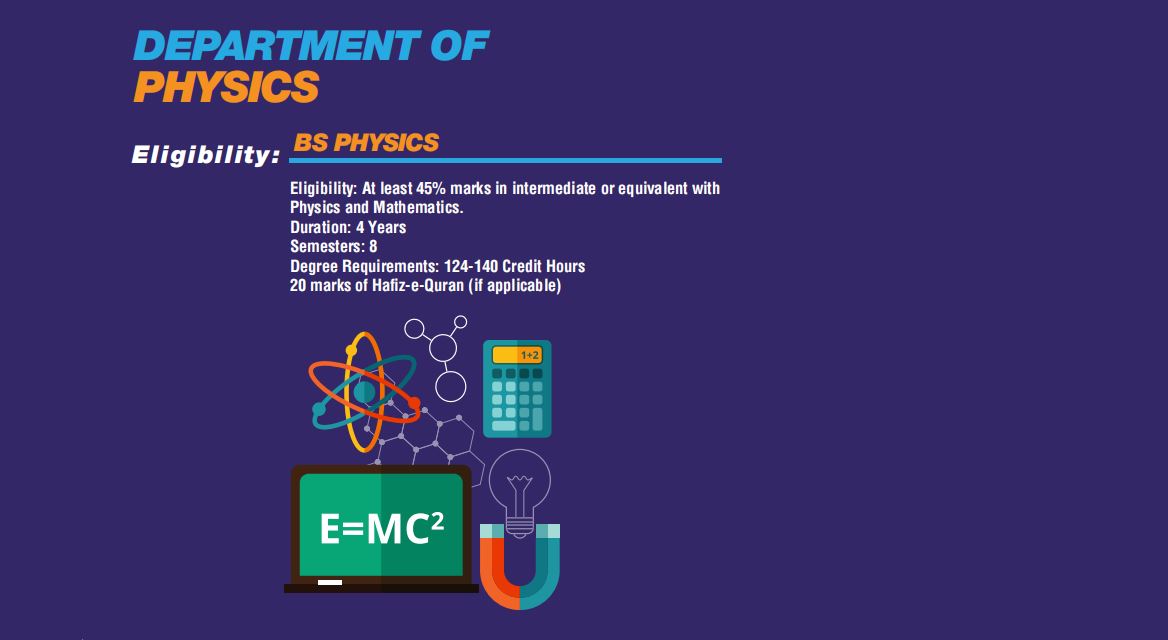
  • Intermediate (FSc Pre-Engineering / HSSC) or equivalent with Physics and Mathematics as major subjects.
  • Minimum marks as prescribed by the university (typically 45% or equivalent for general category).
  • Domicile of Punjab or as per university admission policy.
  • Merit determined by academic record and entry test/Interview if applicable.
Eligibility Criteria

Program Road Map

The BS Physics degree follows an 8-semester structure with core physics courses, mathematics, and laboratory work. The curriculum builds from fundamentals to advanced and applied topics, with optional research in later semesters.
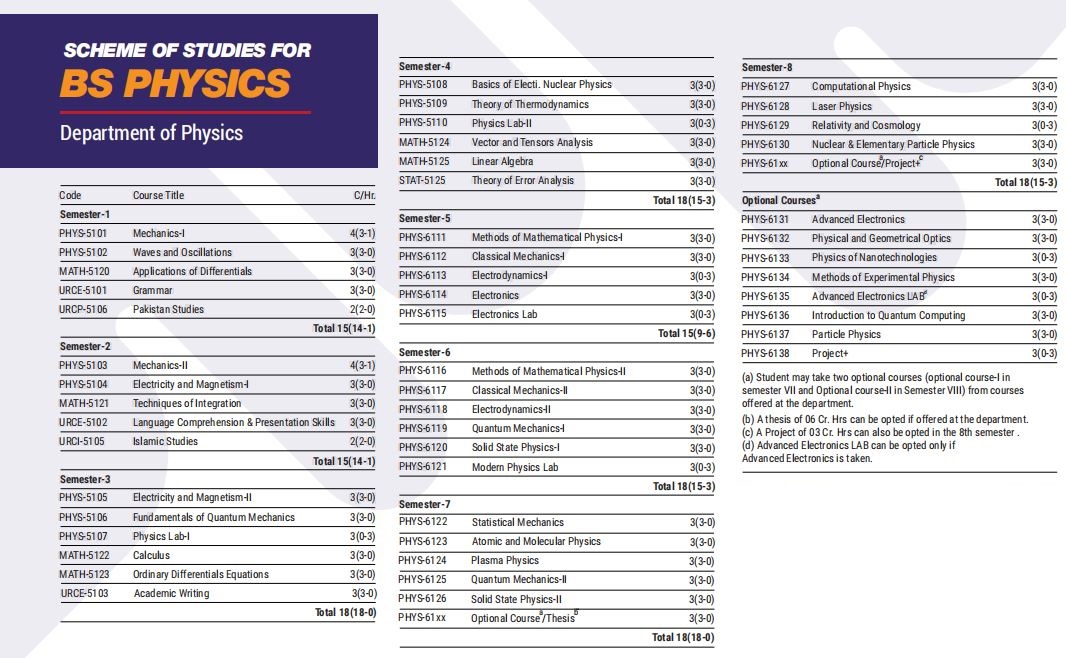
  • Semesters 1–2: Foundation courses in physics, mathematics, and general education.
  • Semesters 3–4: Classical mechanics, electromagnetism, thermodynamics, and lab.
  • Semesters 5–6: Quantum mechanics, modern physics, optics, and electronics.
  • Semesters 7–8: Specialized courses, electives, and research project/internship.
Road Map

Faculty List

Dr. Naseeb Ahmad

Dr. Naseeb Ahmad

Chairperson
Dr. Hashim Farooq

Dr. Hashim Farooq

Assistant Professor
Dr. Khuram Shahzad

Dr. Khuram Shahzad

Assistant Professor

Future prospects

A degree in Physics from Baba Guru Nanak University opens diverse career and further-study opportunities. Graduates are equipped for roles in research, education, industry, and technology, both in Pakistan and abroad.

Further Studies
  • MS / MPhil and PhD in Physics, Applied Physics, or related disciplines.
  • Specialization in condensed matter, nuclear physics, electronics, or computational physics.
  • Interdisciplinary programs in engineering, nanotechnology, or data science.
Career Opportunities
  • Education: Teaching and research at schools, colleges, and universities.
  • Research: Universities, R&D institutions, and national labs.
  • Industry: Electronics, energy, telecommunications, and technology sectors.
  • Government: Scientific organizations, space and nuclear agencies.
Department Vision

The Department aims to maintain high standards in teaching and research in physics, and to produce graduates who contribute to science, education, and technological development in line with national and global needs.

Program Info

Program

BS Physics

Department

Department of Physics

Faculty

Faculty of Natural Sciences

University

Baba Guru Nanak University

Campus

Nankana Sahib

Degree Level

Undergraduate
Enroll Now

What We Offer

Undergraduate Programs: BS Physics
The department supports research in theoretical and experimental physics. Details on specific research areas are available from the department.
Laboratories and facilities for physics experiments and practical training as per the BS Physics curriculum.